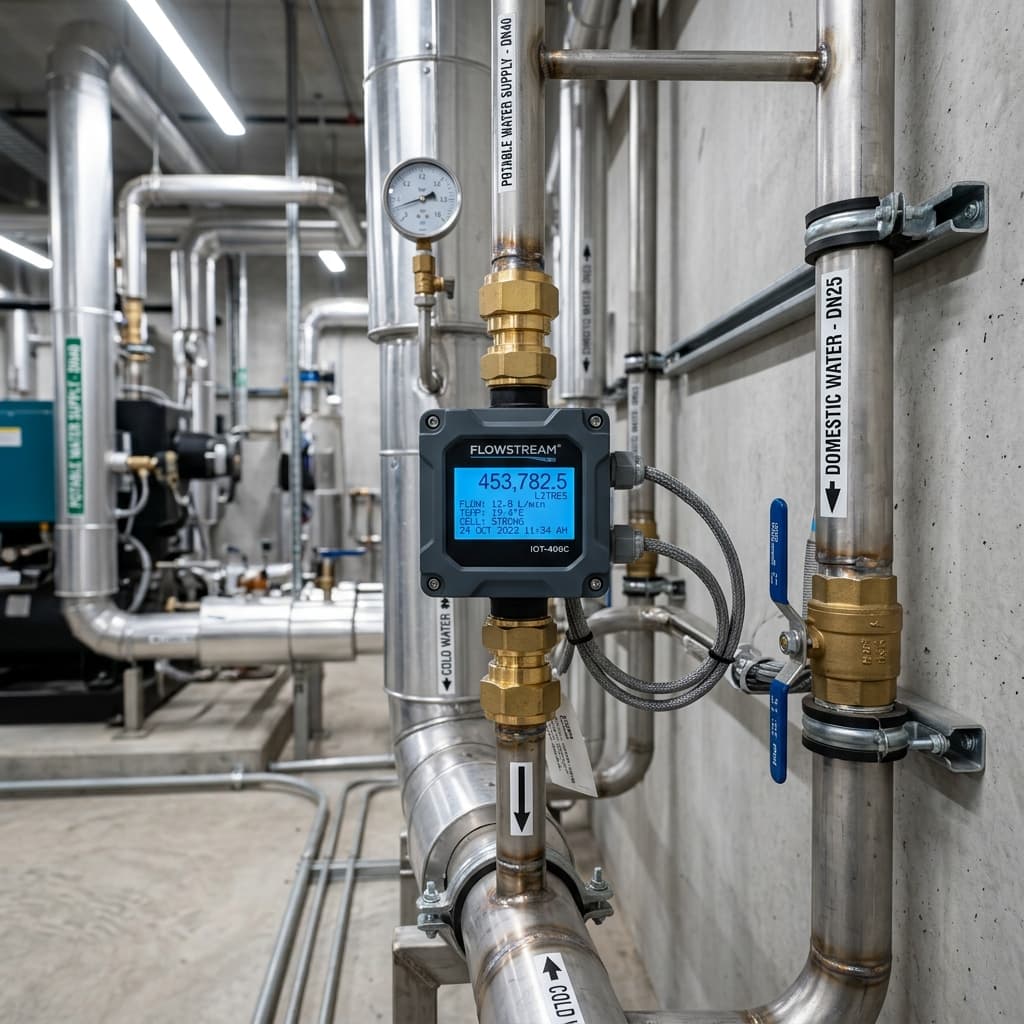
Cellular Water Metering Without Network Setup
Ultrasonic cellular water submetering with instant cloud telemetry. Zero gateway hardware, zero local WiFi, and 10 years of prepaid connectivity included.
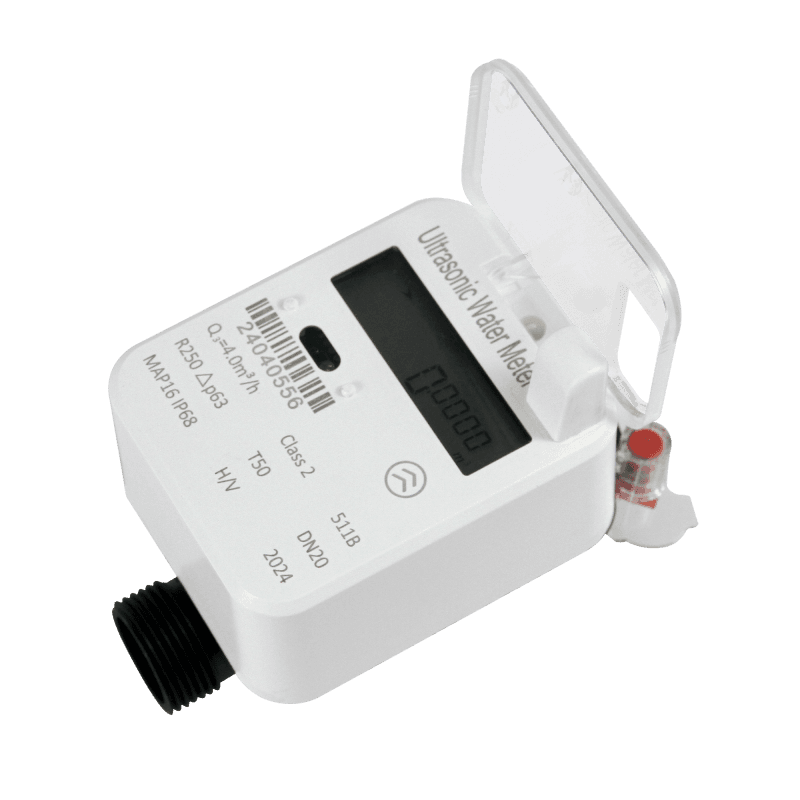
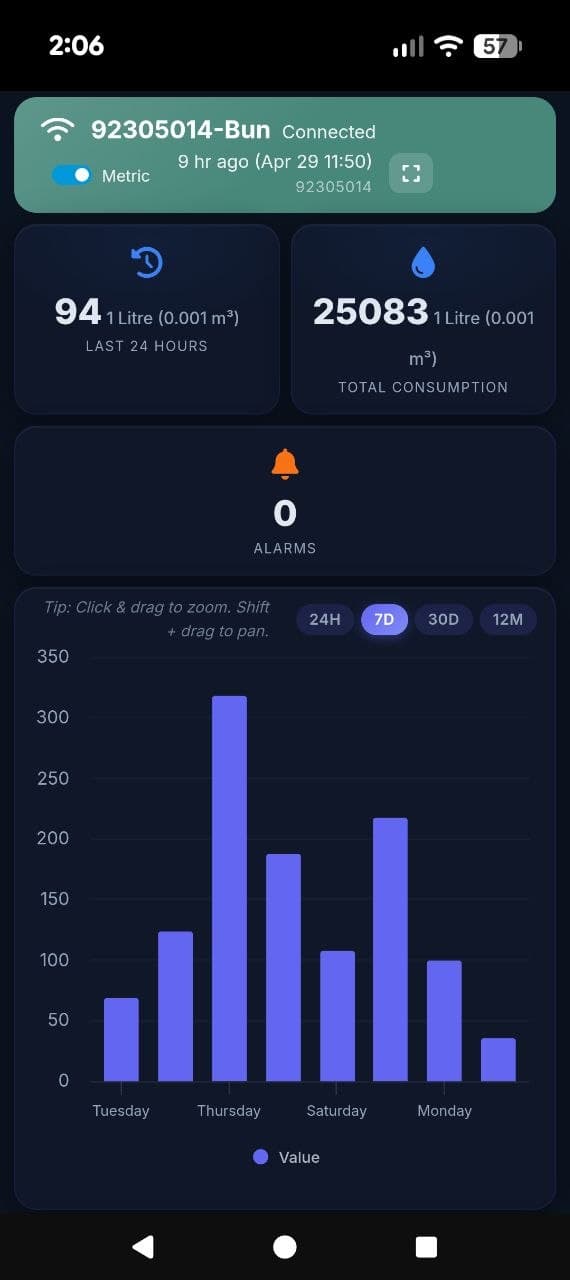
Zero site IT, zero customer WiFi needed. Readings transmit over cellular straight to your phone & tablet.
Built for the places water metering is hardest
Six very different buyers, one architecture. Jump to yours.
Not for you if you are a large city with a healthy, funded fixed AMI network already in the ground. This is for everyone who does not have one — and does not want to own one.
Cellular water meters vs fixed-network AMI
Traditional AMI puts a radio network between your meters and your data. You buy it, permit it, power it, maintain it, and eventually replace it. We put a mobile carrier there instead.
Fixed-network AMI
- 1Meters
- 2Collectors & towers
- 3Backhaul
- 4Head-end server
- 5Your IT team
Capital, permits, poles, maintenance — and a replacement cycle you own.
MaxLinc cellular
- 1Meter
- 24G LTE
- 3Canadian cloud
- 4Your browser
Nothing between the meter and your dashboard that you have to buy or maintain.
Toronto is replacing 470,000 transmitters
The City is replacing every one of its 470,000 units at an estimated $103 million, running April 2026 to December 2028. Until a unit is replaced, those customers receive estimated bills.
Endpoint battery failure is an industry-wide pattern, not a Toronto procurement story. The lesson is about ownership: that is what a proprietary radio layer costs when it fails early. There is no radio layer here to strand.
City of Toronto, 2025The productMaxLinc Cellular Ultrasonic Water Meter
A no-moving-parts ultrasonic meter, IP68 and rated more than 6 years on a sealed battery, that reports over cellular on its own — ten years of connectivity prepaid, and your first year of the app and Canadian cloud hosting included.
Hardware is a one-time purchase and includes the built-in managed SIM with ten years of cellular connectivity prepaid — there is nothing to renew and no connectivity bill later. The app and Canadian cloud hosting are included for your first year, then $1.00 CAD per meter per month, with no contract.
Get a quoteLead-free by construction, not by paperwork
The body is an engineered composite, not brass or bronze. There is no lead in the wetted path to leach into drinking water — and nothing in the water to wear out.
No lead in the wetted path
A composite body has no lead content to leach, unlike the brass and bronze bodies traditional meters are cast from. Safe for potable water.
No moving parts
Ultrasonic transit-time sensing means no piston, disc or turbine sits in the water. Nothing to jam, wear, seize or clog.
Accuracy that holds
Mechanical meters slow down and under-register as they age. Measurement here happens in electronics, so readings stay trustworthy for years.
No corrosion or scale
The body will not corrode, and there is no bearing or gear train for hard water to seize.
The meter is the sensor. The app is the product.
Most of what you would hire a submetering contractor for, without the contractor.
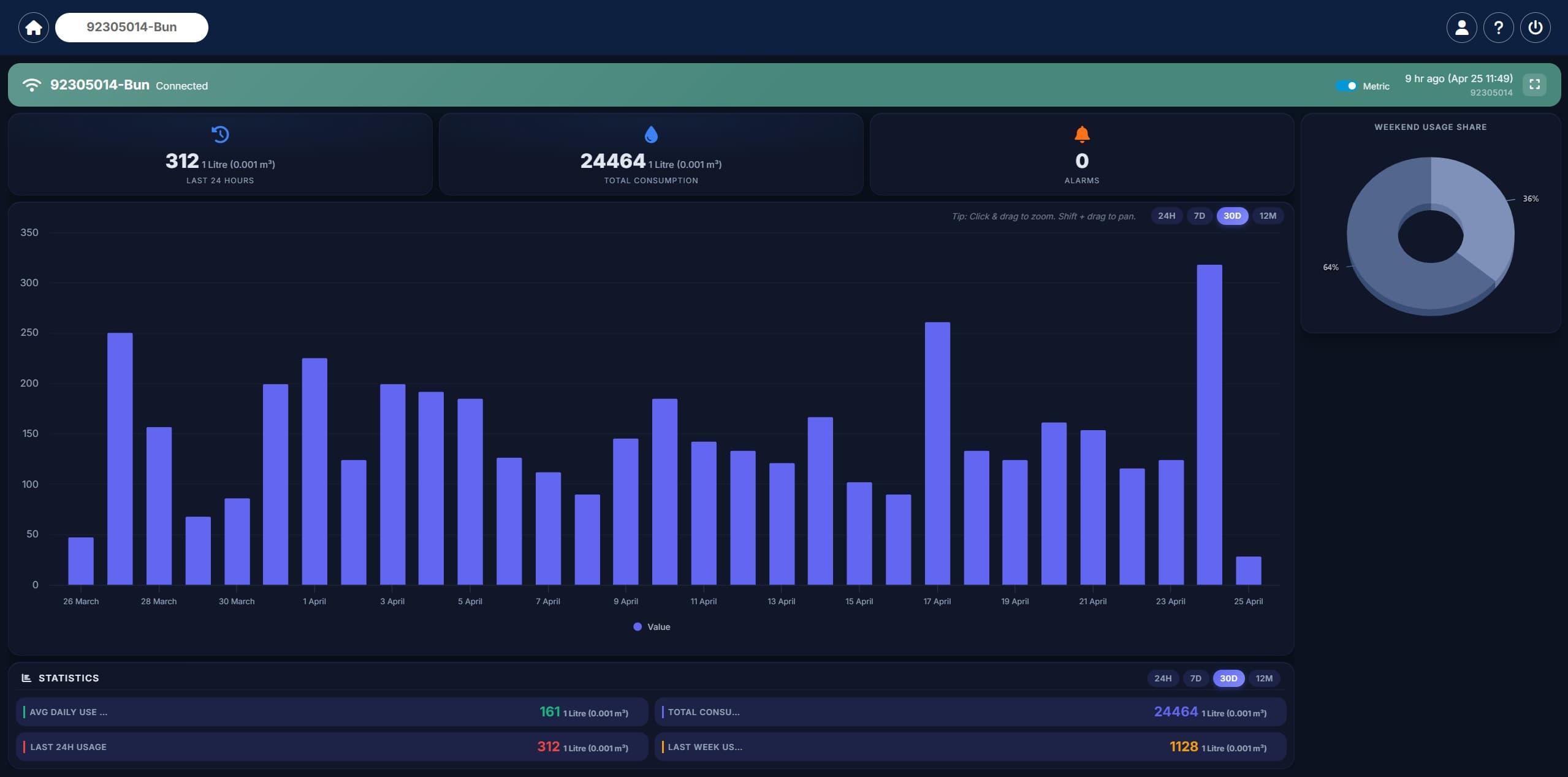
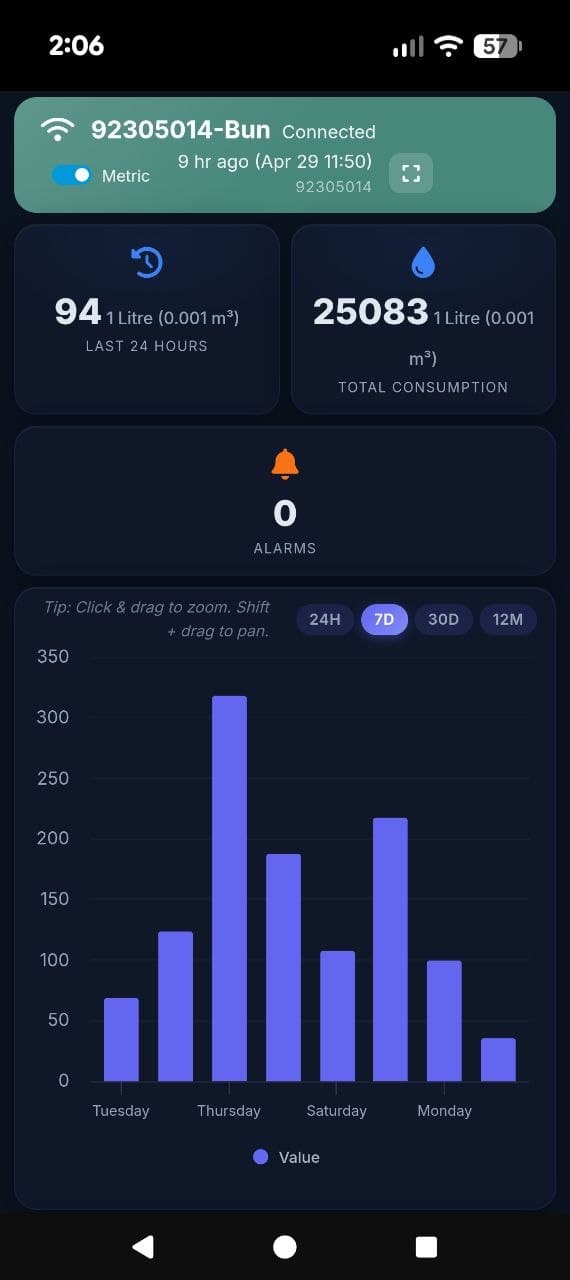
Automatic remote reads
No site visits, no clipboards, no estimated bills. Every meter reports its totals over cellular on a schedule.
Per-unit and per-zone ranking
Sort every suite, pad, building or irrigation zone by consumption and find your worst one in seconds.
Continuous-flow and leak alerts
A wide-turndown ultrasonic meter sees the slow trickle a mechanical meter misses. When flow never stops, you get told.
Smart anomaly detection
The system learns each meter’s normal pattern and flags unusual use — the hidden leak nobody set a threshold for.
Bulk-meter reconciliation
Do your submeter totals add up to the city’s bill? See the gap, and where it is coming from.
Custom consumption alarms
Daily, weekly, monthly, yearly or rolling-window limits. Unlimited rules, per meter or per group.
Reports and export
Daily, weekly, monthly and yearly reports you can view, share or export to CSV/Excel for your billing system.
No-upload and device-error alerts
You learn that a meter went quiet that week. You do not discover it in spring.
Unlimited users, no per-seat fee
Give owners, managers, on-site staff or council their own login. No tenant passwords to manage.
Your consumption data is stored in Canada.
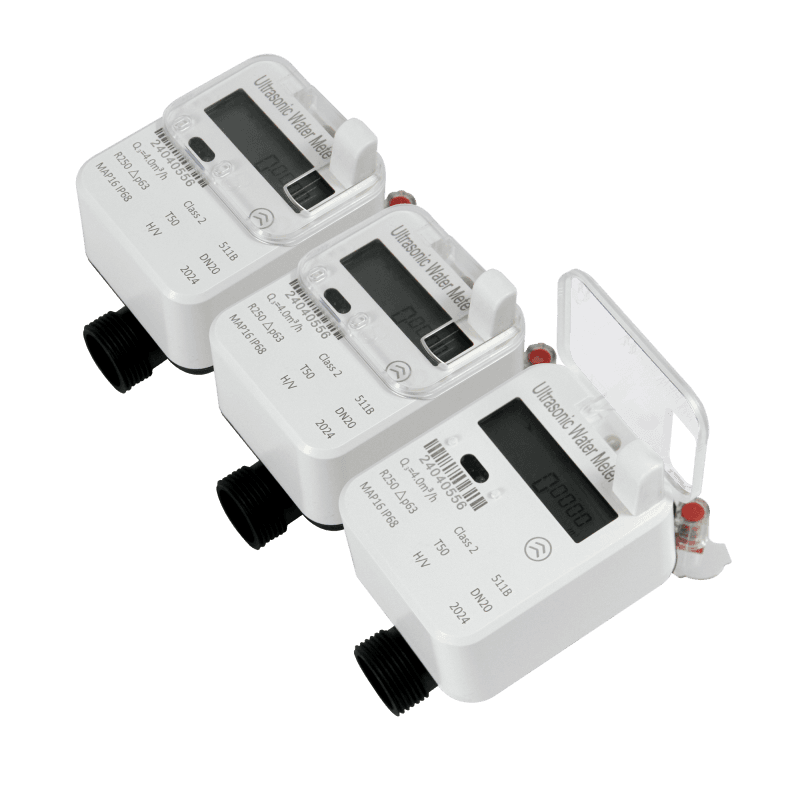
Managed Cellular Telemetry — Zero Infrastructure
Meters report direct to Canadian cloud servers over built-in cellular SIMs. No gateways, repeater mesh, or customer network access.
Water submetering for condos, rentals, commercial sites and municipalities
The same meter and the same app. Very different problems.
Meter 40 homes or 4,000 — with no towers, no collectors and no head-end server.
In May 2025 British Columbia announced a $50-million pilot to install nearly 15,000 automated water meters across 19 small, rural and First Nations communities.
“I have two staff. I cannot own and maintain a radio network after the grant money is gone.”
There is no radio network to own. Each meter talks to the carrier directly, so your cost per meter is identical at 25 and at 2,500 — and there is no collector to re-permit, re-power or replace in fifteen years.
One building meter, 120 suites, and no idea which one runs all night.
Toronto’s Block 1 water and wastewater rate is $4.8629/m³ when paid on time in 2026, and the average household bill rose 3.75% to roughly $1,118.
“Doesn’t a BC strata need a unanimous vote to bill by consumption?”
Only for one of the two routes, and it is the route most stratas do not need. Installing meters and seeing consumption requires no owner vote at all. To re-allocate cost, the usual route is a consumption-based user fee under SPA s.110 and Regulation 6.9 — which expressly allows a fee set on "the user’s rate of consumption" — adopted by a 3/4-vote bylaw. Only changing the strata-fee formula itself falls under s.100, where "unanimous" means every eligible owner, including the ones who do not attend.
A running toilet in one suite costs you about $2,500 a year. You will not see it on a bulk bill.
One toilet running at roughly 1 L/min wastes about 525 m³ a year. At Toronto’s 2026 Block 1 rate of $4.8629/m³, that is roughly $2,500 — from a single suite, on a bill you pay and your tenant never sees.
“Am I allowed to charge my tenants for water?”
Often not, and it depends on your province — see the panel below before you plan any billing. But you do not need billing rights to stop paying for a leak. The recoverable loss is yours today, and one caught leak can pay for the meters.
Your water rate went up again. You still find out what you used sixty days later.
Calgary’s combined water, wastewater and stormwater rates rose 7.03% in 2026. Ottawa approved 4.5% effective April 1, 2026. Meters fit 3/4" and 1" lines — ideal for tenant sub-lines, irrigation feeds and deduct meters rather than a large main service.
“I already have a city meter.”
The city meter gives you one number a quarter. This tells you which line, which building and which shift — and pings you when flow runs overnight that should not. Put a deduct meter on irrigation and you stop paying sewer charges on water that never reaches the sewer. If your main service is larger than 1", tell us the size and we will tell you honestly whether we fit.
No WiFi at the pad. No power at the pit. Nobody on site in February.
IP68 submersible, a sealed lithium battery rated for 6 years at one read per day, and a SIM already inside with coverage across North America.
“It will freeze, flood, or go quiet and I will not know.”
Flooding: IP68, rated for submersion and buried pits. Silence: no-upload and device-error alerts tell you that week, not in spring. Freezing: treat it like any water meter — drain and winterize the line before shutdown. The meter is rated to −25 °C ambient when empty, but water left inside can freeze and split any meter, ours included.
Zone-level water data where there is no power and no internet.
Battery, SIM and an IP68 body that lives in a valve box. Sized for greenhouse feeds, irrigation zones, laterals and barn lines on 3/4" and 1" pipe.
“Will this satisfy my water licence reporting?”
Be careful here: a licence is normally measured at the point of diversion, and an intake is far larger than the 3/4" and 1" lines these meters fit. We are not the right meter for your intake. Where we do help is everything downstream of it — per-zone and per-greenhouse consumption you can export to CSV for your own records.
Deduct meters and sewer credits
You are billed for sewer treatment on water you never send to the sewer. A deduct meter is how you stop paying for it.
Most Canadian municipalities calculate your sewer charge from your total water consumption. Water that goes onto a lawn, into a cooling tower, into a pool or into a product never reaches the sewer — but you are billed as though it did. A deduct meter (also called a sub-meter or irrigation meter) measures that water separately so it can be deducted from the sewer portion of your bill.
Irrigation and landscaping
The classic case. Summer irrigation on a commercial property can be a large share of annual consumption, and none of it reaches the sewer.
Cooling tower make-up
Evaporative loss leaves the building as vapour. Metering make-up water separately supports an evaporation credit.
Water that leaves in the product
Food, beverage and process manufacturers ship water out in the product rather than down the drain.
Fits the lines that matter
Deduct meters sit on the branch, not the main — which is exactly where DN20 (3/4") and DN25 (1") fit.
Credit programs, eligibility and application rules are set by your municipality and vary. Check with your local water utility before you install — we can supply the meter and the consumption records they ask for.
Water submetering rules by province: Ontario, BC, Quebec, Alberta
Monitoring and cost control are available everywhere. Billing is the part that is gated. Here is the honest version.
Ontario
- Monitor use & catch leaks
- Yes
- Allocate cost among owners
- Per condo declaration
- Bill tenants by consumption
- Limited — RTA s.137–138; apportioning capped at 6 units
British Columbia
- Monitor use & catch leaks
- Yes
- Allocate cost among owners
- User-fee bylaw by 3/4 vote (SPA s.110 / Reg 6.9). Changing the fee formula itself needs a unanimous vote (s.100)
- Bill tenants by consumption
- Terms must be in the tenancy agreement (RTB PG 22)
Quebec
- Monitor use & catch leaks
- Yes
- Allocate cost among owners
- Per declaration
- Bill tenants by consumption
- Restricted
Alberta
- Monitor use & catch leaks
- Yes
- Allocate cost among owners
- Per condo bylaw
- Bill tenants by consumption
- By lease terms
| Ontario | British Columbia | Quebec | Alberta | |
|---|---|---|---|---|
| Monitor use & catch leaks | Yes | Yes | Yes | Yes |
| Allocate cost among owners | Per condo declaration | User-fee bylaw by 3/4 vote (SPA s.110 / Reg 6.9). Changing the fee formula itself needs a unanimous vote (s.100) | Per declaration | Per condo bylaw |
| Bill tenants by consumption | Limited — RTA s.137–138; apportioning capped at 6 units | Terms must be in the tenancy agreement (RTB PG 22) | Restricted | By lease terms |
Summary only, current to 2026, and not legal advice. Confirm your route with your strata lawyer or property manager before you change how anyone is billed.
The straight answer on accuracy and billing authority
Water meters are exempt from Measurement Canada’s approval and initial inspection requirements. They remain under its jurisdiction and must maintain accuracy, but water billing authority in Canada is provincial and municipal, not federal.
- No water meter sold in Canada is “Measurement Canada certified” for water. If a vendor tells you theirs is, ask them for the document.
- What actually matters for your bylaw, declaration or lease is metrological performance: ISO 4064 / OIML R49, Class 2, R250, with a 2.5 L/h start flow on DN20.
- Accuracy disputes go to your water utility or municipality.
Most Canadian households still have no water meter
The meter is the cheapest source of new supply a community can buy.
of Canadian households on a municipal water supply reported having a water meter in 2023
Statistics Canada, 2023
per person per day: unmetered flat-rate versus metered volume-billed households in 2009, about 39% less. Associated with metering, not proven caused by it.
ECCC / Statistics Canada, 2009
reduction in water use that the Province of British Columbia says metering can help achieve
Province of BC, 2025
Households with a water meter, by province (2023)
Share of households on a municipal water supply reporting a meter, 2023. Source: Statistics Canada, Households and the Environment Survey. Statistics Canada
There is money for this, and it has deadlines
Comparable metering programs funded in Canada. These are reference programs, not MaxLinc deployments.
Send us your grant deadline and we will return a scoped quote, a spec sheet and a one-page technical justification within 3 business days.
Get a scoped quoteCellular ultrasonic water meter specifications
Everything a consulting engineer needs to drop this into a report.
- Measurement
- Ultrasonic transit-time — zero moving parts
- Accuracy
- Class 2 (ISO 4064 / OIML R49)
- Metrological range
- R250 standard (R400 available)
- Start flow (DN20)
- 2.5 L/h · 0.66 gal/h
- Resolution
- 0.0001 m³ (0.1 L · 0.026 gal)
- Metering
- Two-way, with reverse-flow detection
- Water temperature
- 0.1–50 °C (32–122 °F), class T30/T50
- Max pressure
- MAP16 — 16 bar (232 psi)
- Operating ambient
- −25 to +55 °C (−13 to +131 °F)
- Ingress protection
- IP68 — submersible / buried
- Connectivity
- 4G LTE cellular, managed SIM built in, coverage across North America
- Battery
- Sealed 3.6 V lithium, ~6 years at one read per day
- Body
- Lead-free composite, safe for potable water
- Sizes
- DN20 (G1") and DN25 (G1¼")
Copy-paste specification
Water meter shall be an ultrasonic transit-time type with no moving parts, accuracy Class 2 per ISO 4064 / OIML R49, metrological range R250, two-way metering with reverse-flow detection, resolution 0.0001 m³, maximum admissible pressure MAP16 (16 bar), water temperature range 0.1–50 °C, ingress protection IP68 suitable for submersion and buried installation, body of lead-free composite suitable for potable water service, integral 4G LTE cellular communication with managed SIM and no external gateway or fixed network infrastructure required, and a sealed lithium battery rated for approximately 6 years at one reading per day. Sizes DN20 and DN25.
Full dimensions, flow rates and installation guidance are in the user manual.
Installing a cellular water meter
Short version: it is a plumbing job, not an IT project.
Isolate
Close the shutoff either side of the meter position and drain the line.
Fit
Thread the meter in with the flow arrow pointing downstream. PTFE tape or approved paste — never hemp.
Pressure-test
Restore flow, check for leaks, confirm the display wakes on a touch.
It is already online
No pairing, no configuration, no network to join. The cellular link starts on its own.
Most customers use their own plumber or contractor. There is no commissioning visit, no gateway to install and no site network to configure. In an occupied multi-residential building, budget for suite access and riser isolation — send us a riser diagram and we will come back with a per-door estimate. Ask us if you would like an installer referral in your area.
Typical time per meter: under an hour once the line is isolated.
Before you close a buried pit or a metal-lidded meter box, check the signal screen. A deep vault or a steel lid can block cellular — keep the meter near grade.
Water metering questions people actually ask
What happens when 4G is retired — do my meters become bricks?+
Fair question: the 2G and 3G shutdowns did strand real equipment. Rogers began retiring 3G in August 2025, and Bell and TELUS retire theirs across the rest of Canada on 1 March 2027. So here is the straight answer. No Canadian carrier has announced an LTE retirement — not Rogers, not Bell, not TELUS. We will not tell you they are "committed" to LTE, because none of them has published such a commitment. What we can point to is more useful than a promise: LTE is where all three are moving their 3G customers right now, and Bell’s own shutdown notice tells customers to switch to 4G LTE or 5G. Carriers do not migrate their entire installed base onto a network they are about to turn off. Every Canadian shutdown so far was announced two to three years ahead, and several were then pushed back rather than forward. Independent forecasters do not expect LTE spectrum refarming in Canada before around 2035 — past this meter’s battery life either way. The risk actually worth asking us about is not the radio, it is the connectivity contract: ask what your included term is and how renewal is priced. And if a meter ever does need replacing, you replace a meter — not a tower network, a collector layer and a head-end server, because you never bought them.
What happens at battery end of life?+
The battery is sealed for IP68, so the meter is replaced rather than opened. You get a low-battery alert well ahead of time, so it is a planned swap, not an outage. Rated for about 6 years at one read per day.
How do I know I have coverage?+
Send us an address list and we will run a free coverage check before you order anything. Coverage is across North America on the built-in managed SIM.
Will it survive a flooded pit?+
Yes. The body is IP68, rated for submersion and buried installation. The thing to watch is signal, not water — a steel lid or a deep vault can block cellular, so keep the meter near grade.
Can I dispute a reading without a federal seal?+
Water meters are exempt from Measurement Canada approval and initial inspection, so no water meter in Canada carries one. Disputes go to your water utility or municipality, and what you rely on is metrological performance: ISO 4064 / OIML R49 Class 2, R250.
Can I get the data into my billing software?+
Yes. Reports export to CSV/Excel on any period you like — daily, weekly, monthly, yearly or a rolling window. Unlimited users means your billing clerk gets their own login.
What does it cost after the first year?+
$1.00 CAD per meter per month, and that is the whole list. It covers the app and Canadian cloud hosting from Year 2 onward — there is no contract, no revenue share and no per-user fee, so you can stop whenever you like. It is worth being clear about what it is not: it is not a connectivity charge. The cellular link is prepaid for ten years when you buy the meter, so that stays at $0 whether or not you keep the software. Twenty-five meters comes to $25 a month.
Who owns the meters and the data?+
You do. You buy the hardware outright — there is no revenue share and no service contract that owns your meters. Your consumption data is stored in Canada.
Can I bill my tenants for water?+
It depends on your province and it is genuinely restricted in places — see the province panel above. What is available everywhere is monitoring, leak detection and cost allocation analysis. Confirm billing with your own counsel.
What sizes do you make?+
DN20 (3/4", 20 mm) and DN25 (1", 25 mm). Tell us your line size in a quote request and we will confirm the fit.
What happens to a seasonal site in winter?+
Drain and winterize the line as you would for any water meter. The body tolerates −25 °C ambient when empty, but water left inside can freeze and split any meter. Meters that are drained and left in place keep reporting their status, so you still get a no-upload alert if one goes quiet.
My service is larger than 1". Do you fit?+
Not on the main. These meters are DN20 (3/4") and DN25 (1"). On a larger service they are still useful downstream — tenant sub-lines, irrigation feeds, deduct meters and individual suites. Tell us your line size and we will give you a straight answer rather than sell you the wrong meter.
Start with one site, not a program
A pilot sized to a single approval: a handful of meters, a fixed price, the first year of the app and Canadian cloud hosting included, and a written report at 90 days. If it does not find you anything, you have learned that cheaply.
Prefer to talk it through? Book 20 minutes with an engineer
MaxLinc Technology Solutions Inc., Vancouver BC. Canadian company, Canadian support, cloud hosted in Canada.